





Loading the page…


Shaping the future of software engineering
Product marketing at Resolve AI faces the same structural complexity we solve for engineers.
When you're building a new category—AI for Production Systems—the challenge isn't explaining features. It's connecting dots across domains that don't naturally intersect: technical architecture and business outcomes, engineering workflows and executive priorities, product capabilities and market positioning.
This requires cross-domain expertise. The ability to understand how multi-agent orchestration translates to faster MTTR. How production context maps to engineering velocity. How technical differentiation becomes competitive positioning.
Most product marketing teams struggle here. They know messaging or they know product, but rarely both deeply. They understand markets or technology, but the gap between them remains.
Manveer and Varun don't have this gap. And that changes everything.
Creative product marketing isn't about clever taglines. It's about seeing connections others miss.
When most product marketers look at Resolve AI, they see an incident response tool. That's the obvious framing—engineers use it during incidents, it reduces MTTR, it competes with AI SRE tools.
Manveer and Varun saw something different: engineers spend 70% of their time working with production, not just responding to incidents. Production work spans incident response, cost optimization, development on existing systems, debugging, and operational improvements. The category wasn't "better incident response"—it was "AI for Production Systems."
This insight didn't come from market research. It came from understanding production deeply enough to recognize what the market was missing.
The creative leap was connecting technical reality to category positioning. Production systems are fragmented across code, infrastructure, and telemetry. Engineers need cross-domain expertise to work effectively. Existing tools only cover one domain. Therefore, the category opportunity is comprehensive production AI—not point solutions for specific workflows.
That's creative product marketing: seeing the shape of the problem clearly enough to define a new solution space.
Consider how Resolve AI differentiates from coding assistants.
The obvious approach: "We do production, they do code." True, but not compelling. It positions Resolve AI as complementary—different use case, different workflow.
Manveer and Varun went deeper. They understood that the hardest engineering work isn't greenfield code generation. It's building on existing systems—extending production architectures, adding features to brownfield codebases, understanding how changes impact running systems.
This requires production context. Which services will be affected? How do existing patterns constrain the solution? What infrastructure dependencies matter? Coding assistants can't answer these questions because they only see code, not what's actually running.
The positioning became "Build on existing systems"—a use case that directly challenges coding assistants on their home turf while highlighting Resolve AI's unique capability. Not "we're different," but "we solve the harder version of the problem you thought you solved."
This only works if you understand both the technical architecture (why production context matters) and the competitive landscape (what coding assistants actually do). Technical depth isn't separate from positioning—it enables positioning that competitors can't easily copy.
The technical architecture behind Resolve AI is sophisticated: multi-agent orchestration, hypothesis-driven investigation, continuous learning from production interactions.
Most product marketers would explain this in technical terms and hope prospects connect it to business value. Or they'd skip the architecture entirely and just talk about outcomes.
Manveer and Varun do neither. They translate architecture to capability to value—maintaining technical credibility while making business impact clear.
Multi-agent orchestration becomes "combines expertise across teams"—immediately understandable to engineering leaders who know that production investigations require pulling in people from multiple domains.
Hypothesis-driven investigation becomes "deep investigation with evidence"—addressing the pain point that most tools just surface data without explaining what it means.
Continuous learning becomes "builds institutional knowledge"—solving the real problem that tribal knowledge lives in senior engineers' heads and gets lost when people leave.
Each translation preserves technical accuracy while making the value proposition concrete. Engineering leaders see both how it works and why it matters. This is rare in product marketing—most messaging forces prospects to choose between technical depth and business clarity.
The Resolve AI messaging framework isn't a slide deck. It's an executable system for maintaining consistency across every customer touchpoint.
It defines not just what to say, but how to structure narratives. The problem build-up follows a specific sequence: scale of production work, complexity of systems, organizational fragmentation, context-sharing burden, universal challenge, solution reveal. Each frame builds recognition before presenting the solution.
It specifies word choices with precision. "Working with production" instead of "production operations." "Cross-domain expertise" instead of "full-stack knowledge." "Autonomously investigates and resolves" instead of "automates incident response." These aren't arbitrary preferences—each choice positions Resolve AI in a specific category space.
It maps personas to messages. Engineering leadership hears "distribute expertise across your team." Application engineers hear "resolve incidents without waiting for platform support." Platform engineers hear "scale your expertise and provide architectural guidance." Same product, different framing based on what each persona needs to hear.
This level of specificity only comes from deeply understanding both the product and the market. Manveer and Varun built a system that anyone can execute—but the system itself required creativity that most product marketers don't have.
When product marketing understands the product deeply, everything compounds.
Sales conversations become more effective because the narrative matches how prospects actually think about their problems. Engineering leaders recognize the problem build-up because it mirrors their lived experience.
Product development gets clearer direction because positioning defines what capabilities matter. "Build on existing systems" as a use case directly informed product priorities—it's not just marketing fluff.
Customer success can articulate value in customer terms because the messaging framework maps capabilities to outcomes. When customers ask "how is this different from our observability tool," the answer is precise and consistent.
Content marketing has a foundation. Every blog post, case study, and technical deep dive reinforces the same core positioning. The category gets defined through repetition and consistency.
This is what creative product marketing enables: a compounding system where every piece reinforces the others. Not because of rigid templates, but because the underlying understanding is coherent.
Manveer and Varun don't just market the product. They shape how the market understands the problem.
Before Resolve AI, the market saw production work as separate point solutions: incident response tools, observability platforms, coding assistants. Each category addressed one workflow.
Now, engineering teams are starting to see production as a unified problem space. Not "how do we respond to incidents faster" but "how do we give every engineer the cross-domain expertise to work with production systems effectively."
This category creation doesn't happen through advertising spend. It happens through consistent, credible messaging that makes prospects see their problems differently. That requires product marketers who understand production systems as deeply as the engineers building them.
The result: Resolve AI doesn't compete in existing categories. It defines a new one. That's the ultimate product marketing outcome—and it only happens when creativity comes from technical depth, not marketing tactics.
As Resolve AI expands across the production lifecycle—alert triage, incident investigation, remediation, debugging, development—the product marketing challenge grows.
Each capability needs positioning. Each use case needs messaging. Each persona needs a narrative that connects their specific pain to Resolve AI's specific value.
This requires the same cross-domain expertise Resolve AI provides to engineers. Understanding how technical capabilities map to business outcomes. How product architecture enables competitive differentiation. How market positioning influences product priorities.
Manveer and Varun have built the foundation: a clear category position, consistent messaging framework, and technical credibility that resonates with engineering leaders.
Now the challenge is scaling that foundation as the product and market evolve. Not by diluting the message, but by maintaining the same depth and creativity that defined the category in the first place.
That's what makes product marketing at Resolve AI creative: it solves the same cross-domain complexity problem the product solves. And it does so with the same rigor, precision, and technical depth that engineers expect from production systems.
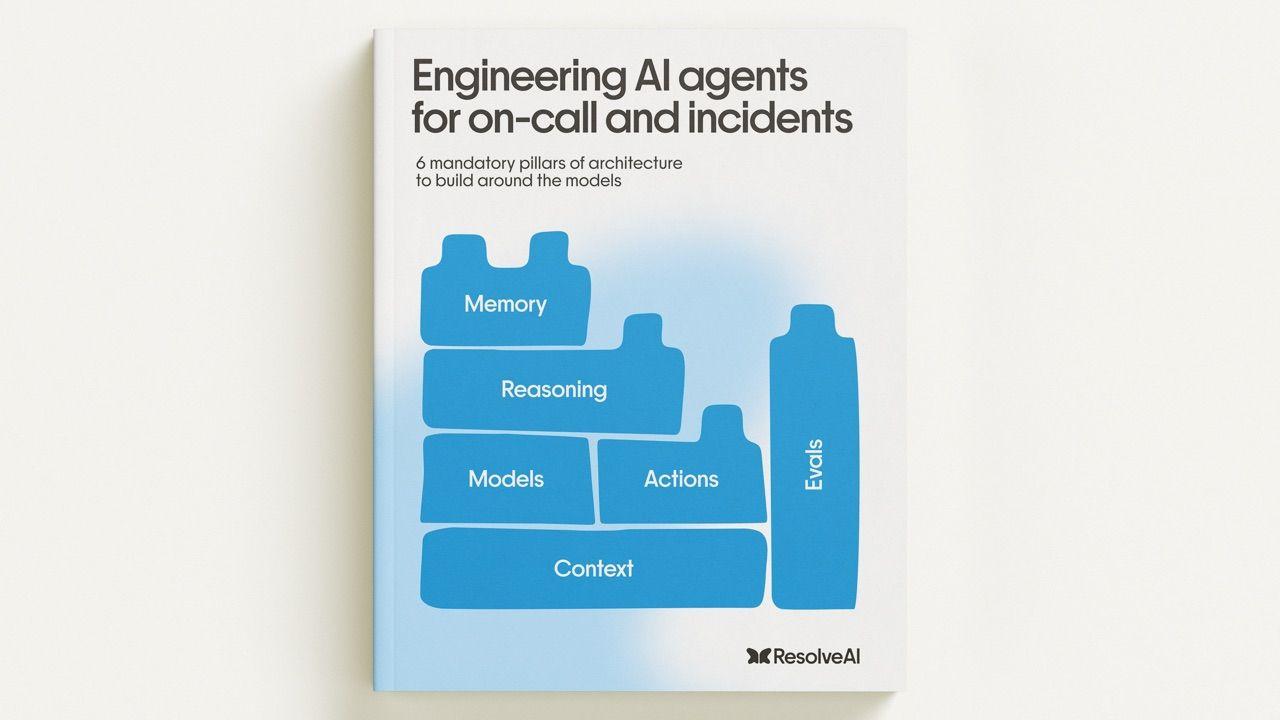
AI for prod ebook
Learn how top engineering teams use AI to run production.
See the agents that run and fix software in action
Join our engineering leads for "Behind the Build", a webinar series deep-dive into how we built agents that run software.